



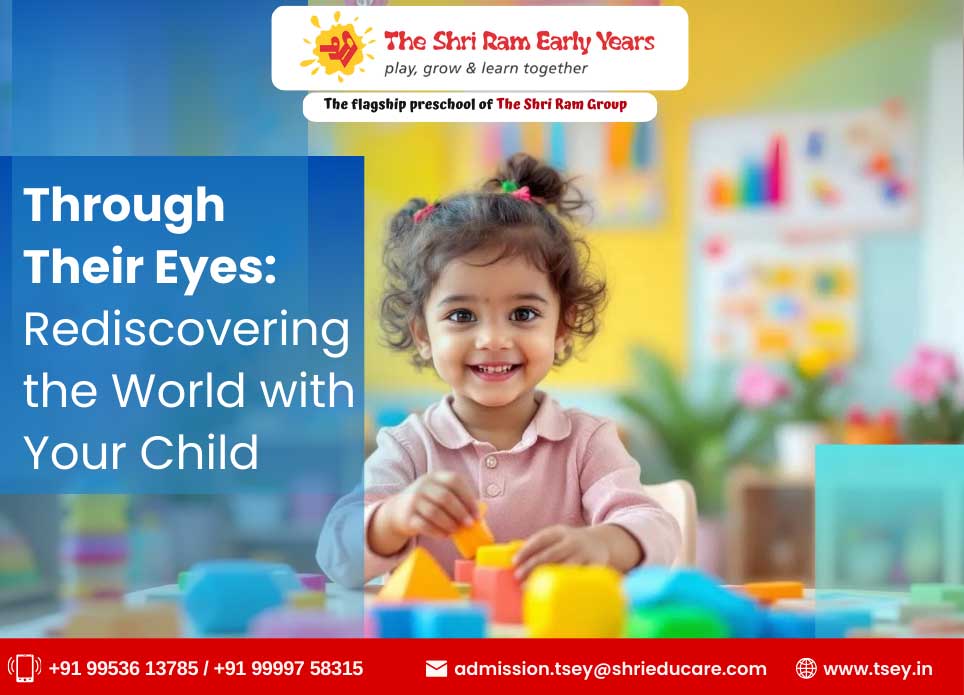
You have experienced the jolt into your toddler’s world, where nothing is too small to be fascinating and no moment is too ordinary to explore, if you have ever stopped in the middle of a busy morning because your toddler noticed a snail inching across the sidewalk.
Eventually, as adults, we exchanged our awe for calendars, checklists, and traffic reports. But kids? In their alternate reality, a cardboard box is not a box at all; rather, it is a spaceship, a bakery, or a hidden fort. The smell of rain is a major event.
This is a blog about that world, and why entering this space every day, even for just a few minutes, might be the greatest thing you can do for your child (and yourself).
The Simple, Little Things Hold the Biggest Lessons
The child’s interest in a puddle is not only “cute” in the moment or to fulfill a curiosity. It’s science in action.
The ripples in the water, the sinking pebble – each is an experiment that tests a theory and makes a prediction. They don’t need a lab coat; they need scope and space – to try, ask why, and make a beautiful mess.
And we as parents often feel the pull to “teach” – numbers, alphabets, and shapes – and those are important. However, to pay attention to the world and really slow down and see is equally vital. Scientists, in fact, say that kids who are prompted to check out the world around them when they’re young often become better problem solvers later on.
The Gift of Being Unhurried
Modern parenting feels like a race – get kids enrolled early, get them out the door quick, and keep them ahead. Which is not how it is for children who are supposed to develop, not just reach a finish line. Slowly. In layers.
A child spending 30 minutes organizing and sorting leaves by size or color is NOT “wasting time” – they are building their order sense, practicing categorization skills, and acquiring patience.
All we have to do is resist the urge to say, “Come on, let’s go.” At times, the kindest thing we can do is step aside and witness how their timeline unfolds.
Your Child’s Language is Play
We want to believe that play is a departure from learning, but rather, in reality, play is the work of childhood. They use role-play to challenge social limits (“Can I be the shopkeeper this time?”), exchanging rules and functions and articulating emotions that soar beyond words.
It might be a tower of blocks collapsing for us, but it is a lesson in resilience to them. Playing tea party is not only adorable – it’s the early rehearsal of empathy, hospitality, and shared experience.
And here’s the kicker: the more we do that, play along without ever controlling it, the more they bring you into their minds, fears, and dreams.
Where Curiosity Meets Community
Home is the first classroom, but a child’s social world opens up when they interact with other children. Watching a peer manipulate their way through a puzzle or hearing another child’s solution within a story circle not only helps to build information – it builds perspective.
They also learn some of the big human stuff there, like patience and compromise, and the silent joy of helping a sibling succeed. Hence, the importance of their learning environment – not only for what they are learning academically, but also for shaping the kind of person they’re becoming.
Why We Need to See the World Like They Do
The truth is, your child does not need a perfect parent. They need a present one.
That is paying attention to when they get a little breathless because they saw a cloud that looks like a dragon or when they ask the same question for the fifth time because they’re still making sense of the answer.
When we stop to understand the way in which they see the world, we begin not only to connect more completely – but also to somewhat reacquire something that we have misplaced: amazement.
Choosing the Right Space for Wonder to Grow
However, as parents, what we usually mean when we look for the best preschools in Gurgaon or the best play school in Gurgaon is much more than this – it is a place where our child’s wonder of the world isn’t stifled, their sense of self isn’t smothered, and their creativity isn’t cut down.
Because the correct early environment is not only a preparation for “school”; it prepares kids for life.
A Closing Thought
Because in the end, early childhood is not a race – it is about planting roots deep enough to last a lifetime. And though the home is where the roots first begin, a good preschool will help your little one grow into this happy and confident child ready to conquer outside their doors.
In TSEY, every day is an opportunity for kids to learn while doing things they love in a place that values the magic of those formative years. And not just an education, but a childhood well lived.


