



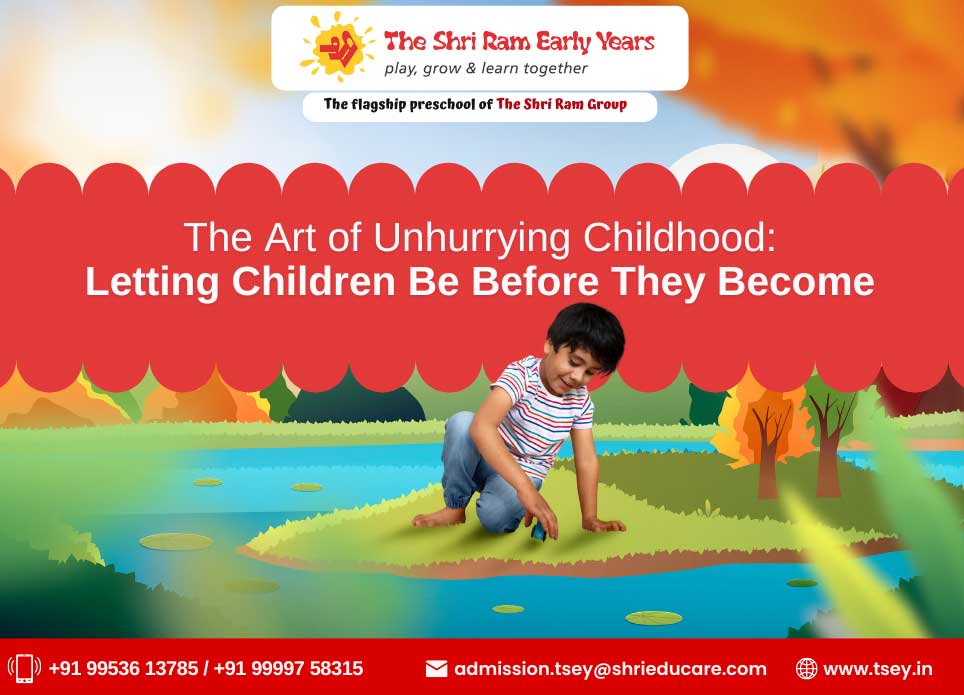
 In a world that rushes to tick every box – grades, milestones, outcomes, achievements – childhood often becomes a race before it even begins. From the moment toddlers utter their first words, the clock starts ticking. Are they walking “on time”? Can they identify colours, count to ten, recite the alphabet? And in this gentle, formative phase of life, the pressure to become often overtakes the joy of simply being.
But suppose we turned the story around? How about if early childhood were not regarded as preparation for school, but as a unique and precious stage in itself?
The Lost Art of Slowness
Children aren’t in a hurry. Watch them closely. They’ll spend 10 minutes looking closely at a stone. They’ll talk to ants. Out of a stick and a leaf they will make a story. This slowness isn’t laziness – it’s their way of learning. It’s deep, sensory, exploratory. It’s deep, acceptive sensory exploration. They’re not collecting data; they’re cultivating relationships with the world.
And yet we overwhelm our kids, in between adult anxieties and cultural pressures, by forgetting what early learning looks like – not an acceleration of everything, but an attention to the element. Real attention. The kind that allows for pause, wonder, touch, giggle, fall and rise.
Play is Not a Break from Learning. It is Learning.
The floor becomes an ocean. A block becomes a bridge. A blanket becomes a dragon. This is not just cute – this is intellectual white-driven heavy-lifting at its best. Imagination, storytelling, decision-making, empathy, collaboration – they’re all happening during unstructured play.
When a preschool school is organized around play, it’s not a rejection of learning; it’s a celebration of the most natural aspect of the child’s learning process. Learning that is alive, lived, and self-directed.
What if we expected less of children and listened to them more? Not “What did you learn today?” but “What was something that made you laugh today?” “What surprised you?” “What did you wonder about?”
The Myth of “School Readiness”
There is a prevailing narrative that preschool’s role is to prepare children to be “ready” for big school. But preparedness is not a checklist. It’s not about handwriting or learning the months of the year. True preparedness lies in emotional security, community confidence, inquiry, and interpersonal navigation.
A child that is safe to express, explore and screw up will adjust, academically, in any future learning environment. But a kid taught to comply, perform or win approval may have a hard time when asked to stretch his wings and think on his own.
So, maybe it’s time we start asking, not “Is this child ready for school?”, but “Is the school ready for this particular child?
Listening to the Unspeakable
Small children don’t always use words to express their needs. Their emotions emerge in movement, tantrums, silence, play. It requires a patient adult to interpret these non-verbal expressions in a compassionate, rather than punitive, manner.
The most effective caregivers and teachers are not the ones who respond to every behaviour, but those who can decode what underlies it. It’s that kind of responsive care that transforms a space into a real day care in Gurgaon or anywhere else – not just one that keeps kids from getting hurt, but one that makes them feel visible.
When little children feel heard, they learn to trust the world. And that trust is the basis of all future learning.
Parents: The Co-Explorers
The notion that “parents are a child’s first teachers” is not a kind saying, but a neuroscientific fact. A child’s brain is most affected by the people they are emotionally attached to. What they learn is not what we teach them but who we are, how we conduct ourselves, how we respond, how we connect.
So, when a preschool school really partners with the parents, it’s not just by providing news updates and report cards. It invites them in – to the learning, the wondering, the hard-fought small victories and challenges. It becomes a marriage in the fullest sense.
Such partnership respects the child as the primary voice, not a passive receiver of adult messages. And then, when that does happen, learning is truly organic, dynamic and naturally occurring.
A Childhood Unrushed
It’s tempting to desire that for our children – that they “get ahead.” To teach them young, to “ready” them for a constantly competitive world. But in doing so, we may be teaching them something else altogether: to rush. To strive. To overperform. To overlook joy.
And the hard math, here, is that no amount of early academics can make up for a childhood well-lived. What lasts is not whether they learned to read at 4 or 6, but whether they learned to trust themselves, to voice, to wonder, to link.
A child who knows their voice is heard is ready to take on the world; one who ticks performance boxes is not.
In Conclusion: So, Where Do We Begin?
We begin by unlearning.
And we can do that by shifting our focus from outcomes to experiences.
By valuing people over profit.
By acknowledging that the early years are not a ‘waiting room’ for ‘real’ education, but a whole universe filled with meaning, movement and magic.
We select spaces – both at home and out in the world – that leave room for slow learning, emotional growth and self-discovery.
And if you are looking for such a space, one that honours the rhythm of childhood but also embraces a nurturing and a stimulating environment, The Shri Ram Early Years in Gurgaon is just that place. Rooted in empathy, play, and child-led philosophies, it is now the trusted option for those parents searching for a preschool school or a day care in Gurgaon.
Because TSEY never hurry childhood. It celebrates it. Just as it should be.


